 |
 |
 |
 |
 |
 |
 |
 Archived Newsletters Archived Newsletters |
 |
 |
|
|

|
|

|
101 Years Old - A Re-look at EOQ
The EOQ formula, still widely used in inventory management to calculate the optimum production run or purchase quantity, was originally developed in 1913 by Ford W. Harris. Since then, inventory and operations management has seen a lot of changes, so are we still justified in using it? Let's first examine the basis for the formula and look at the underlying assumptions.
Harris wanted to answer the question, "what quantity to make at once?" He postulated that there are two variable costs arising from batch production; a setup cost and an inventory holding cost. By adding these together, he arrived at the total cost, and if the total has a minimum for one particular order quantity, then that would be the optimum, or Economic Order Quantity (EOQ).
He calculated the annual setup cost per order as the cost of doing a setup (or changeover) times the annual number of setups required:

where:
S is the setup cost
A is the annual production
Q is the batch quantity
This assumes that the setup cost is the same for every batch and varies proportionally to the number of setups. It is also assumed that the annual production quantity is fixed.
To calculate the annual holding cost, Harris first assumed that the average inventory is equal to half the batch quantity and to get a cost he multipled this by the percentage of the inventory cost providing for the overheads incurred in keeping stock. These are the cost of capital used to finance the stock and the warehousing costs.

where:
i is the inventory holding cost rate per annum
C is the unit cost of the item being produced
Q is the batch quantity
The assumptions here are that the cost of the item is fixed over a year, that the rate of demand is constant, that each batch is delivered at once and that the warehouse overheads vary proportionally to the amount of stock being held.
We can graph these costs as a function of the batch, or re-order quantity, and add them together to show the total cost wth respect to quantity:

Using differential calculus, Harris discovered that the minimum of the total cost curve occurs when the setup, or ordering cost equals the holding cost, as shown in the graph above.
Solving for Q gives the familiar square root formula for the EOQ:
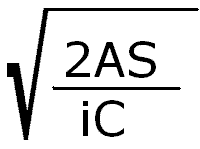
101 years later, we are still using this formula to calculate manufacturing batch sizes as well as purchase order quantities and it is probably used by your 21st century software. But, is it still valid?
Let's first look at whether we should be using the formula for purchased items. We've assumed that the setup (ordering) cost is the same for every batch and varies proportionally to the number of setups (orders). Is this true for purchased items? Suppose we increase the order quantity, and as a result, place fewer orders. If the assumption is valid, the cost of ordering should reduce. For purchased items, the cost of ordering consists mainly of payroll costs in buying, accounts payable and stores receiving, but in reality the payroll costs do not reduce unless staffing is reduced and this almost never happens! Dr Cecil Bozarth, Professor of Operations and Supply Chain Management at North Carolina State University, has coined the term "Relevant" costs to apply to those costs which are actually affected by the order quantity. (See http://scm.ncsu.edu/scm-articles/article/economic-order-quantity-eoq-model-inventory-management-models-a-tutorial#3) Back in 1913, the cost of stationery and postage would have certainly been Relevant costs, but today we email our orders so there is effectively no difference in cost when we vary the number of orders. There are no longer any Relevant ordering costs and substituting zero for S in the formula will produce an EOQ of zero! What this means is that you can forget the EOQ formula and order the smallest practical quantity permitted by the capacity of your organization. If you can handle a maximum of n orders a year, then dividing the annual quantity by n is your order quantity. Will you lose out on quantity discounts? No, suppliers will give price-breaks according to annual spend, rather than individual order quantities.
The conclusion for purchased items is, the EOQ formula is no longer valid and there is no justification for using it! Let's look at an actual example of how this has been used to improve supply chain performance.
Epping Engineering (not the real name) has been buying castings in batches of 30, because that's the figure calculated from the EOQ formula, using an ordering cost calculated by dividing the total costs of the buying, receiving and creditors departments by the total number of orders placed. The figures used to calculate the order quantity Q were:
Annual demand A
= 36
Ordering cost S = R2 985
Holding cost i = 20%
Unit cost C = R1 100
The inventory planner has just completed an inventory management course presented by Colin Seftel and now knows that the EOQ formula should not have been used. She finds out that it would be beneficial to the company's cash flow to order just one month's supply at a time and that the buying, creditors and receiving departments can handle the additional work. By reducing the order quantity from 30 to 3, the company is able to reduce the average stock holding by 90% from 15 to 1.5 at no extra cost, and because they pay the supplier 30 days from statement, the stock is effectively financed through the credit given by the supplier.
How about manufactured items, are the assumptions still valid? It's true that the setup cost does vary proportionately to the number of setups, but is it the same for every batch? Some changeovers can be done faster than others, so the answer is not always. A much better way to use the formula is to solve for S and calculate what the setup cost should be in order to permit economic manufacture of a desired batch quantity.
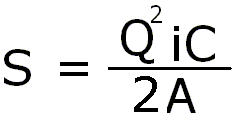
Setup costs are not fixed. With the right staffing, tooling and ingenuity, setup times and therefore costs, can be drastically reduced. Compare the time taken to change the tyres of a Formula One car with a commercial tyre dealer or a DIY mechanic! At Epping Engineering, the inventory planner had another look at the batch quantity being used for a milled side-plate. Based on a setup time of 45 minutes, which represented a setup cost of R3 375, the EOQ formula gave a batch quantity of 5.
Annual demand A = 12
Setup cost S = R3 375
Holding cost i = 20%
Unit cost C = R17 536
However, only two units were actually needed at any time to meet customer demand. She calculated that, in order to justify a batch size of 2, the setup cost would need to be reduced to R585, or 8 minutes. She discussed this with the machinist, who pointed out that the workpiece could be set up on the workbed of the milling machine while the previous part was still being made. As a result, the time that the machine was stopped for change over would be reduced to about 5 minutes, justifying the batch size reduction. The resulting reduction in average inventory would be 1.5, or 67%.
In the past 101 years, the focus of manufacture has shifted from producing as much as possible, to meeting customer demand, so the order quantity should match the customers' demand rate. The ideal batch size is thus predetermined by the supply chain -- manufacturing's task is to determine how to make that quantity economically.
The conclusion for manufactured items is, the EOQ formula is still valid, but should rather be used to calculate the desired setup cost.
Colin Seftel CFPIM CSCP