 |
 |
 |
 |
 |
 |
 |
 |
 Archived Newsletters Archived Newsletters |
 |
 |
| Email: info@psq.co.za Phone: 021 557 2491  Subscribe to our Newsletters |
 |
| Newsletter |
Does the Demand Driven methodology apply to my company?
By Bernard Milian, CPIM CIRM DDLP DDPP

We are all different…
The question is a recurring one.
“We manufacture to order, is this relevant to us?”
“For the automotive industry, yes, but we are in the aerospace industry, we have many more items!”
“We have many constraints, is it compatible?”
“It’s for large corporations, isn’t it? We are a SME!”
“Okay for simple products, but when we have complex bills of materials?”
“Yes, but at home it’s different ” Is it not?
Every company is different, of course. For each company, a suitable
management model is required. Is the Demand Driven model for you?
The risk of standardization
Methods,
standards, and best practices allow us to progress. However, applying a
standard model to a company is not necessarily a great idea. Let us
take the example of the MRP logic incorporated in our ERP systems. This
same logic has been used throughout the industry: Forecasting, Sales
& Operations Plan, Master Production Schedule, Dependent Demand,
Materials Requirements Planning, Safety Stocks, DRP, etc. Was it always
appropriate? Obviously not, with sometimes dramatic consequences.
So be careful and suspicious: if you are told about a new magic model such as “Demand Driven,” DDMRP,
DDAE, DDOM, etc., take the time to understand what it means for you and
to transpose it to your business reality! Take the time to understand
what is truly in it for you!
A wide variety of case studies
I
was fortunate in early 2014 to attend the Demand Driven conference held
in the USA, one of the first meetings between companies, then pioneers,
that had deployed Demand Driven methodologies.
I was amazed by the diversity of the contexts presented then. There was
a testimony from a large FMCG group, from a company manufacturing
custom excavators for the mining industry, and even from an ETO
(Engineer to Order) company – designing their products to order in a
project mode. There were large groups and SMEs.
I am talking about a time before the rise of DDMRP. “DDMRP compliant”
software didn’t exist yet, in fact the event at the time looked like a
Demand Driven Technologies user conference, which was then three years
old.
Since then, the DDMRP methodology has spread across the industry,
compliant software has proliferated, major ERP vendors have recognized
its relevance, and case studies flourished. Feel free to explore our case studies or those on the Demand Driven Institute website, you will find all types of contexts!
Yes, it is for you, but…
When
does the Demand Driven model not apply? At our March user conference,
Chad Smith, co-founder of the Demand Driven Institute, summed it up
this way...
- If your company does not face variability (in demand, supply, management)
- And if your cumulative
procurement, processing and delivery lead times are shorter than your
customers expectations
… then Demand Driven is not for you!
Maybe if you are running a very over-capacity 3D printer shop to do additive manufacturing you escape these criteria, otherwise…
However, it is important to realize that the Demand Driven model
comprises a coherent set of techniques, processes, and tools, but that
the implementation must be adapted to each one. This is one of the
strengths of the methodology: the first step is to design the Demand Driven model that suits your company now. And then to evolve and adapt this model over time.
MTS, MTO, ETO, VATI, all different!
Each
type of company and flow has its own appropriate techniques. If you are
in a MTS mode (make-to-stock, distribution channel, retail), the basic
DDMRP techniques will apply perfectly well, all along the chain.
If you are in an MTO (make-to-order) or mixed MTO / MTS mode, DDMRP
techniques can be applied, rather upstream of the chain, on recurring
components or semi-finished products. But to control your end-to-end
flows, you need to implement a complete control model, integrating the
scheduling of the critical control points of your flows, and the
mechanisms of capacity buffers and time buffers. This is known as the
DDOM (Demand Driven Operating Model).
If you are in ETO, you will also use DDOM techniques, which you may
need to complement with Critical Chain Project Management (CCPM)
techniques.
The nature of your flows will also lead to different problems and
different management logics. We usually categorize the flows under the
VATI acronym, as described in the diagram below.
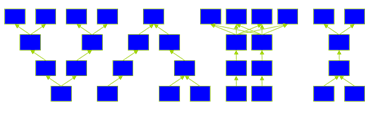
For
example, if your flows are V-shaped (a multitude of finished products
are produced and distributed from a few base components), your
challenge will be to differentiate as late as possible and take
advantage of relative priorities aligned with actual demand.
If you are in A (manufacturing of assemblies gathering multiple
components), your challenge will be to enable short assembly lead time
by securing the availability of components / semi-finished before
assembly. Each context has its own adapted model.
Not adapting your management model can have disastrous effects. For
example, there are many “V” companies that have implemented a standard
MRP / DRP model, since this was the standard promoted by their ERP
software. These companies spend a lot of efforts to forecast at the
most detailed level (the top of the V), and aggregate them upstream,
which mechanically leads to unreliable forecasts, and generates from
the source a very variable and distorted signal, hence unbalanced
inventories. If you are in V, do not do that!
Adapt your model and adopt the right tools
Get in Touch

For more information, contact Ken Titmuss
Copyright © 2021 Demand Driven Technologies. All Rights Reserved. Reproduced with permission